
Sunday, December 14, 2008
the Meiji restoration begun when Japan opened its borders after the Tokugawa Shogunate closed Japan's borders to the foreigners at the start of the Tokugawa Shogunate. it all started when the emperor tried to bring back all its powers from the Shogunate.then those events leads to the Boshin War which was won by the Emperor and the start of the restoration and the end of the Tokugawa Shogunate.
The Opium War
The Opium War was basically about two wars that were between China and a bunch of Western countries. The first one was between Great Britain and China. Early in the 19th century so Basically the Opium War was caused when the imperialist nations wanted the good things from China such as Silk, and spices. But they didn't want to pay too much and had difficulty finding products the Chinese would want to buy. So their ships would be full in both directions.
Opium was found to be enjoyed by the dock workers and their families so more and more was brought in to China.
The Emperor saw the degeneration and corruption of the people caused by the Opium and threw the Imperialists out and burned the Opium stocks - Some Imperialists went to Hong Kong and set up business there on a Lease that expired not so long ago.

Opium was found to be enjoyed by the dock workers and their families so more and more was brought in to China.
The Emperor saw the degeneration and corruption of the people caused by the Opium and threw the Imperialists out and burned the Opium stocks - Some Imperialists went to Hong Kong and set up business there on a Lease that expired not so long ago.
Mountains of the Moon
This film was based on a novel By William Harrison and the travel of Victorian explorers Richard Burton and John Hanning. The film traces the friend ship between two people Burton and John that grows during their adventure through Africa to find the source of the Nile. This Movie is recommended to anyone. Speke(John) has a homosexual crush on Burton. Burton is a sympathetic character . The romance between Isabel and Burton is played up. Burton has a strange scene where he kills a man to end his enslaved suffering at the hands of great pain . This movie is very dramatic. "Two strangers made friends by a savage land. Two friends made enemies by the civilized world"


Karl Marx & Communism
Karl Marx didn't really like the Industrial Revolution , and Engels basically created it. He hated the pollution and the child labor him and Engels made a book called "The Communist Manifesto". He dislike for capitalism, is which drove him to make communism. Communism was a form of socialism that eliminated private ownership, and favored a classless society. The reason he made communism was because of the workers that had to work 16 hour days everyday with poor working habitats and low pay. Karl's plan for communism was genius everyone would be paid the same the government owned everything so there would be know fighting , the thing with communism was that it looked good on paper but it didn't work to well in real life, doctors were being paid the same as wood chippers that's why it never worked. Karl Marx's plan was bound to fail.

Karl Marx & the Industrial Revolution
 Karl Marx was a philosopher, political economist and was known for creating the idea of Communism. Marx's rise to popularity began during the Industrial Revolution. He was shocked at the sight of the workers. The conditions were terrible and the workers were being treated very poorly. They were making products that weren't theirs and depended greatly on money wages. He said that the factory owners would own the factories instead of the landlords. He encouraged the workers to unite and revolt.The Industrial Revolution had many effects that was brought a lot of people from the country to the city. It led to higher standards of living, as inexpensive manufactured goods came on the market. & it increased trades between other nations It. People who were against the government, were treated bad. Karl Marx died in the year 1883 and only few people went to his funeral


Sunday, October 19, 2008
Nationalism and the Creation of Italy
Nationalism is an optimistic feeling and things you do in support and to serve your country.Nationalism is being loyal and devoted to your country. Nationalism can be anything you do that serports your country. Things such as Saying the National Anthem, Fighting and maybe even dying for your country, Rooting for your home team in the olympics, etc. There are a lot of ways to become a Nationalist. But the main way is by creating a country or starting a revolution.
One country that is a good example of Nationalism is Italy. As we all know Italy was mad up of a bunch countrys. Now its one big boot shaped country. In 1871 all of the countrys came together to make Italy


One country that is a good example of Nationalism is Italy. As we all know Italy was mad up of a bunch countrys. Now its one big boot shaped country. In 1871 all of the countrys came together to make Italy
Simon Bolivar and Latin American Revolutions

Simon Bolivar waz born in Caracas on July 24 1783, his family basque orgin established in Venezuela since the end of the XVI century and which has occupied a social and economic position in the province.
His parents were Colonel Juan Vicente Bolívar y Ponte, and Concepción Palacios Blanco. He had two older sisters and a brother: María Antonia, Juana and Juan Vicente. There was another girl, María del Carmen, who died at birth. Before he was three years old, Simón lost his father, who passed away in January of 1786.
Bolivar basicallyy tried to unite the Spanish nations of South America at the Congress of Panama but there were too many differences between the countries to allow this. Bolivar then returned to Colombia to resume his presidency, but much had changed. He had never really held power long enough to garner much support and on top of this the peoples of Ecuador, Venezuela, and Colombia had many ethnic differences that could not be solved by putting them together in one country. Bolivar tried to counter these problems by lobbying for more executive power and then declaring himself dictator but this could not save the country.
Tuesday, September 23, 2008
Robespierre and The Reign of Terror
After the death of Louis XVI in 1793, the Reign of Terror began. The first victim was Marie Antoinette. She had been imprisoned with her children after she was separated from Louis. First they took her son Louis Charles from her. He disappeared all of a sudden with out knowing where when or how. The guillotine, the new instrument of egalitarian justice, was put to work. Public executions were considered educational. Women were encouraged to sit and knit during trials and executions. The Revolutionary Tribunal ordered the execution of 2,400 ppl in Paris by July 1794. So manyy people died at least 30,000 people lost their lives..
The Terror was designed to fight the enemies of the revolution, to prevent counter-revolution from gaining ground. Most of the people rounded up were not aristocrats, but ordinary people. A man (and his family) might go to the guillotine for saying something critical of the revolutionary government. If an informer happened to overhear, that was all the tribunal needed. Watch Committees around the nation were encouraged to arrest "suspected persons, ... those who, either by their conduct or their relationships, by their remarks or by their writing, are shown to be partisans of tyranny and federalism and enemies of liberty". Civil liberties were suspended. The Convention ordered that "if material or moral proof exists, independently of the evidence of witnesses, the latter will not be heard, unless this formality should appear necessary, either to discover accomplices or for other important reasons concerning the public interest." The promises of the Declaration of the Rights of Man were forgotten. Terror was the order of the day. In the words of Maximilien Robespierre, "Softness to traitors will destroy us all."
The old maxim "the end justifies the means" describes Robespierre's policy well.
When Robespierre called for a new purge in 1794, he seemed to threaten the other members of the Committee of Public Safety. Robespierre was arrested and sent to the guillotine the next day, the last victim of the Reign of Terror.
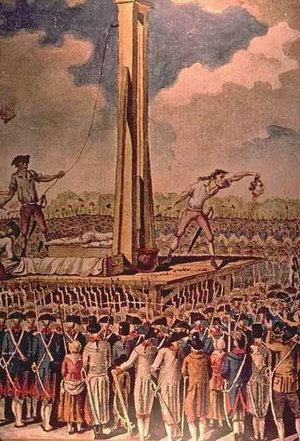
The Terror was designed to fight the enemies of the revolution, to prevent counter-revolution from gaining ground. Most of the people rounded up were not aristocrats, but ordinary people. A man (and his family) might go to the guillotine for saying something critical of the revolutionary government. If an informer happened to overhear, that was all the tribunal needed. Watch Committees around the nation were encouraged to arrest "suspected persons, ... those who, either by their conduct or their relationships, by their remarks or by their writing, are shown to be partisans of tyranny and federalism and enemies of liberty". Civil liberties were suspended. The Convention ordered that "if material or moral proof exists, independently of the evidence of witnesses, the latter will not be heard, unless this formality should appear necessary, either to discover accomplices or for other important reasons concerning the public interest." The promises of the Declaration of the Rights of Man were forgotten. Terror was the order of the day. In the words of Maximilien Robespierre, "Softness to traitors will destroy us all."
The old maxim "the end justifies the means" describes Robespierre's policy well.
When Robespierre called for a new purge in 1794, he seemed to threaten the other members of the Committee of Public Safety. Robespierre was arrested and sent to the guillotine the next day, the last victim of the Reign of Terror.
Monday, September 22, 2008
The French Revolution
The French Revo is one of thee most important events in major historyy. It was more radical than either the english or American Revolutions, and had a far great impact o the 19th century Europe. The Unthinkable fall of the Bourbons resonated throughout Europe, sparking a series of revolutions which rallied behindd liberalism and nationalism. The major socialist revolutions of the 12th century in Russia, China and Cuba were inspired by the french's example. Before the revolution the French people were divided into 3 groups: the 1st estate consisted of the clergy, the second estate of the nobility and the third estate of the bourgeoisie, urban workers, and peasants. Legally the first two estates enjoyed many privileges, particularly exemption from most taxation.
The first estate, the clergy, consisted of rich and poor. There were very wealthy abbots, members of the aristocracy who lived in luxury off of wealthy church lands, and poor parish priests, who lived much like the peasants.
The second estate, the nobility, inherited their titles and their wealth came from the land. Some members of the nobility had little money, but had all the privileges of noble rank. However, most enjoyed both privileges and wealth.
The third estate, the common people, was by far the largest group of people in France. Everyone who was not a member of the first or second estates was a member of the third. It included the wealthy merchants whose wealth rivaled that of the nobility, the doctors and lawyers, the shopkeepers, the poor, and the peasants who worked the land. Obviously, a very low group.

Thursday, September 18, 2008
John Locke and "The Enlightenment"
John Locke was born in the year 1632 and died in the year 1704, an English philosopher. Locke's services to his country and to the cause of civil and religious liberty, his famous because of the Essay Concerning Humane Understanding. His purpose was to inquire into the powers of the human understanding, In his views on government Locke was a disciple of Hobbes, but he was not slavish in his discipleship. He believed with Hobbes that government is the result of an original contract, but the state of nature preceding the establishment of government he did not believe to be a state of war. Society is a meaning of better enjoyment of natural rights. When the people enforce their will against the government, there is no rebellion. They are acting within their rights. In ethics he was a hedonist. Good and bad are still equal to pleasure and pain or their causes. It's good because they told them there punishment with pain for disobedience if they really deserved it. The law-imposing authority may be divine or human.

Friday, September 12, 2008
Copernicus and the trial of Galileo
_Copernicus and the Trail of galileo
Galileo Galilei born in the year 1564 he was a scientist from Italy scientist who formulated the basic law of falling objects , which he verified by careful measurements. Galileo Galilie was also the one and only, first human to see Jupiter and many of the stars in our solar system with his own eyes. Galileo was famouse because he inventened the telescope. He's the one who opened the door to modern astronomy. He spent half his life just by expermienting. Galilio researched the stars for over 20 years before he told anyone if he was right or wrongg , and without a doubt, that the earth moves around the sun inside our solar system. His dedication to the study of the planets and his determination to stand behind what he believed in is a reminder that beliefs are only as strnge as those who believe in them and the truth will set us free. The catholic chruch of course didn't believe him because they thought it was bad that he was trying to prove them wrong. Galileo Galilie died in the year 1642.

Galileo Galilei born in the year 1564 he was a scientist from Italy scientist who formulated the basic law of falling objects , which he verified by careful measurements. Galileo Galilie was also the one and only, first human to see Jupiter and many of the stars in our solar system with his own eyes. Galileo was famouse because he inventened the telescope. He's the one who opened the door to modern astronomy. He spent half his life just by expermienting. Galilio researched the stars for over 20 years before he told anyone if he was right or wrongg , and without a doubt, that the earth moves around the sun inside our solar system. His dedication to the study of the planets and his determination to stand behind what he believed in is a reminder that beliefs are only as strnge as those who believe in them and the truth will set us free. The catholic chruch of course didn't believe him because they thought it was bad that he was trying to prove them wrong. Galileo Galilie died in the year 1642.
Thursday, September 11, 2008
Scientific Revolution: The Scientific Method
Back in the old days people got answers to their questions in several ways. One way was actually by the scientific method, you ask your self a question you want to know. First you would have to research all the information that you can about your topic, the next step is to guess, and what would you think, this is known as the hypothesis. In order to show that your hypothesis was right or wrong you have to experiment. You should write out a procedure, a procedure is like showing things step by step. Materials you need could also be listed when i say step by step i mean the steps of the experiment than can be followed out clearly. When you are done writing out your experiment, you need to do it to see and test you hypothesis. Experiments are done to gather data. It is very that you follow your procedure, make good observations while doing the experiment, and keep records or charts to help you out. Another part of the scientific method are the results. Results are showing what happened after performing the experiment.
An example of the scientific method is like asking something like " Can a plant grow with out sunlight? " I would gather information about plants and their relationship with the sunlight. Now I have to think about what would happened if one plant didn't have sunlight and the other did. My educated guess would be that a plant cannot grow without sunlight because sunlight is where most plant's and trees get energy, to make food in order to survive. I gather my materials ( 2 seed plants, the sun and a dark place) I write what I'm going to do step by step with these materials, then preform my experiment. When days or even weeks pass I can make a chart which one is growing or if they both are. I see that one plant did not grow (the one with no sunlight) and that the other one did (the one with sunlight.) So therefor I saw that my hypothesis was correct.
Friday, September 5, 2008
Evolution vs. Creation
Creation is basically about people who believe that Earth-humans, animals, and the whole universe were all created by God. There's a book that explains most creations, the book is called The Bible, in the book of Genesis it shows how the universe was created, which most people believe in. In every religion there is a God-or a higher power-people who are so religious may not really believe in science. There are some proofs about creation but hard to believe.
The concepts of Evolution is also a theory believed by scientists. It is believed that scientists don't believe in such a higher power or a religion, they can be considered atheist or agnostic. All scientific ideas have evidence like fossils, stones, foot prints, etc. Evolution is an idea of humans evolving from primates (monkeys) and than into cave men. Humans evolved from a common ancestor. Humans have evolved back then and since then, we are still evolving.
In my opinion, I thought about it and I don't know which one to believe in because its hard to choose. Evolution and Creation both have it's evidence.
The concepts of Evolution is also a theory believed by scientists. It is believed that scientists don't believe in such a higher power or a religion, they can be considered atheist or agnostic. All scientific ideas have evidence like fossils, stones, foot prints, etc. Evolution is an idea of humans evolving from primates (monkeys) and than into cave men. Humans evolved from a common ancestor. Humans have evolved back then and since then, we are still evolving.
In my opinion, I thought about it and I don't know which one to believe in because its hard to choose. Evolution and Creation both have it's evidence.
Thursday, September 4, 2008
Subscribe to:
Posts (Atom)